Six years ago, I decided to obtain a teaching certification in Belgium. Like with many things in my life, just like my life itself, it all started because of my father.
Until then, I had sworn that I would NEVER (read: never ever) go teaching, since half of the family (grandfather, mother, father, brother, aunt, uncle, ...) had been teaching and I decided “I did not want to become just like one of them”, remembering the all-too-loud family reunions with endless discussions destined to change the world. I had been unwillingly excused for most of these remarkable events, since I ended up working in the hotel and restaurant industry, where the grass was green and the girls were pretty.
At some point in time during my career as a young Chef, I realized that earning all that money and working up till 16 hours a day in a stressful environment wasn't bringing me all the answers in life. Although I had everything one could possibly dream of, I was not completely happy. So I asked myself: “Can you remember a time when you were happy? What where the circumstances? Why where you happy then?” And this personal quest brought me back to the days were I had almost no worries: the days I spent at school. Why? Life at school is organized, structured. There is routine. There are rules. With the occasional exception, that means your official part in the modern slavery system only happens from nine to five.
So when my father, administrative director of a hotel school, asked me if I was willing to temporarily replace a teacher on sick leave, I decided it was time to accept my family legacy in the education department.
In my 4 years of teaching, I probably learned as much as all my pupils together. I widened my interests. That is what I like about decisions: they create some sort of snowball-effect. Usually, we end up covered by the snow because of unexpected circumstances or other people's decisions, e.g. somebody ending a long-lasting love relationship. The nice thing about taking decisions yourself is that you are in control. Once in control, you are better prepared for the unforeseen situations in life, since you learned to be responsible and accountable. It somehow makes it easier to recognise the events that happen beyond your control, and it helps in order to accept them. Being adventurous and taking that doubtful decision broadens your horizon. You will always be able to look in a direction where the sun or the stars are shining.
I like the way Leonard Modlinow talks about how “people like to exercise control” in his book The Drunkard's Walk, a book that deals with randomness in our daily lives (and that is also what this article is about):
“many of the same people who drive a car after consuming half a bottle of Scotch will freak out if the airplane they are on experiences minor turbulence”.
During my extremely turbulent ride as a newbie teacher, I met Koen. Koen was taking his teaching certification at the same institution, and one afternoon, during a coffee break (or was it a beer break?), we ended up talking about our shared passion for hiking in the mountains. A few months and beers later, we spent two weeks in the snowy mountains of central Norway, with a magna cum laude certification in our dangerously overloaded backpack.


We still laugh about the scene where I simply said “No thanks!” to this most beautiful Norwegian blonde girl that, clearly interested, asked if we needed any help, standing in front of a street map in Oslo.

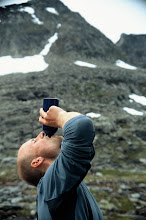
It might be Koen's educational background in back-end computer programming that sharpened his mind to pull off those notorious jokes with perfect timing. He is a really funny guy, with a good sense of humour. My favourites are his exceptional impersonation of Sean Connery with the sentence “On screen I look older” ([On 'Ssqueen Ije Loek 'Aulde] or something like that.) and the unforgettable 'Shrimpin' business' scene with Bubba from the award-winning movie Forrest Gump (see picture).

In Norway, somewhere on the highest point in the mountain range we were climbing, we did a mysterious archoleogical discovery (see picture).

How and why did these extremely heavy, strangely shaped and decorated objects end up in a place that is at least a full day hike away from civilization? Maybe the blonde girl in Oslo would have known the answer... If you know what this is, please mail us. No, you will not win that Samsung flatscreen TV, since we ourselves don't know what it is so we cannot verify your answer.
In the meantime, the Belgian brewery company Interbrew had grown into one of the world's biggest breweries InBev. Koen and I decided to organize a short city trip to Rome. Organizing meant: booking flight tickets, and that's it. Maybe because I was gradually gaining more control over my work life, I started enjoying the poor planning and the unknown, thus leaving plenty of room for sheer adventure in my spare time.
In Rome, we lingered in the streets for 3 days, being led by the scents of the city, the wind in the trees, the local inhabitants and their houses. We did not go to the main tourist attractions. Of course, we inevitably saw some of the monuments, but we deliberately avoided being 'the average tourist'. Ever since our journey in Norway, we found that this 'more natural' way of travelling, of following our instincts, could make a trip so much more interesting and rewarding, whilst the world famous tourist venues, apart from being over-crowded, often left us with a feeling of disappointment. One can read all there is to know about the Sistine Chapel in a book, but how can one experience the atmosphere and odours of the streets in Rome, the glow of the sun on the face of a local as it is setting in Tyrrhenian Sea? I decided to honour this way of life by inventing the saying:
'Visiting Rome without seeing the Colosseum'.
Just back in Belgium from the capital of Italy, I realized that Koen must have said a lot of silent prayers at the Vatican, since I received an e-mail from my aunt: “is anybody interested in flying to Andalucia for the weekend? We had bought these tickets, but due to act of God, we can't make it...”
We landed on a sunny morning in Malaga, barely recovered from our Roman indulgences the week before. We had no accommodation booked, no plans... actually, we had no idea at all where we were. So after an hour walk and two legendary Sean Connery impersonations, we came to a bus station. Instead of storytelling on the bench with a box of chocolates, we decided to jump on a random bus.
The bus must have taken us through one of the most ugly parts of Spain: the entire coastline of Malaga seemed one big building project, catering for the British and German tourists and pensioners. This seemed to go on for miles and miles, until the bus took us inland, through the mountains. Our final destination was Ronda.
In Ronda, which turned out to be one of the most beautiful towns on this planet, I suddenly realized that I was not far from the production region of one of the top wines in the world: Sherry. (Jerez/Xerez); a wine with no match that had previously gained my interest and favour since I had been both learning and teaching about it in hotel school. It didn't take me long to convince Koen that the typical dry Fino and Manzanilla wines are the ultimate accompaniment to Tapas, the typical counter food from Spain. This lead us to Cadiz, Jerez and finally San Lucar de Barrameda, where, while enjoying a Fino and looking out over the Atlantic, we suddenly decided to catch a train to Sevilla.
In Sevilla, we happened to have arrived in the midst of the Semana Santa festivities, and all kind of strange things were happening around us. The oddest thing of all was that I encountered two colleagues from work, which amongst themselves, had accidentally run into each other in Sevilla. And all of this was happening because my uncle could not make it that weekend... Now, if you read The Drunkard's Walk, you will understand that situations like that are actually all very normal, they are even statistically predictable to a great extent. With a romantic soul like mine, it is hard to believe that such encounters would not happen for a reason and that they would not be orchestrated by some divine force.
Since I emigrated to South Africa 3 years ago, Koen and I virtually didn't see each other, apart from a few catch-up-over-a-beer-sessions we had whenever I was visiting family in Belgium. That finally changed when Koen flew over to South Africa last month. And of course, we focused on regions that attract fewer tourists than other parts of South-Africa: the Karoo and the Cederberg area. In Tulbagh, temperatures were reaching almost 40 degrees Celcius. When Koen was taking pictures of the area, he would bring up Sean Connery and say: "On screen it looks colder". You can have a look at our pictures in my photo gallery.
I hope you enjoy the pictures. And I truly hope that next time, in your travel, you follow your instinct and not the tourist guide. That you may explore unvisited places and try new things, by letting that random factor lead you. By 'Visiting Rome without seeing the Colosseum'.